fuse*:
Mimicry, 2025
A/V installation
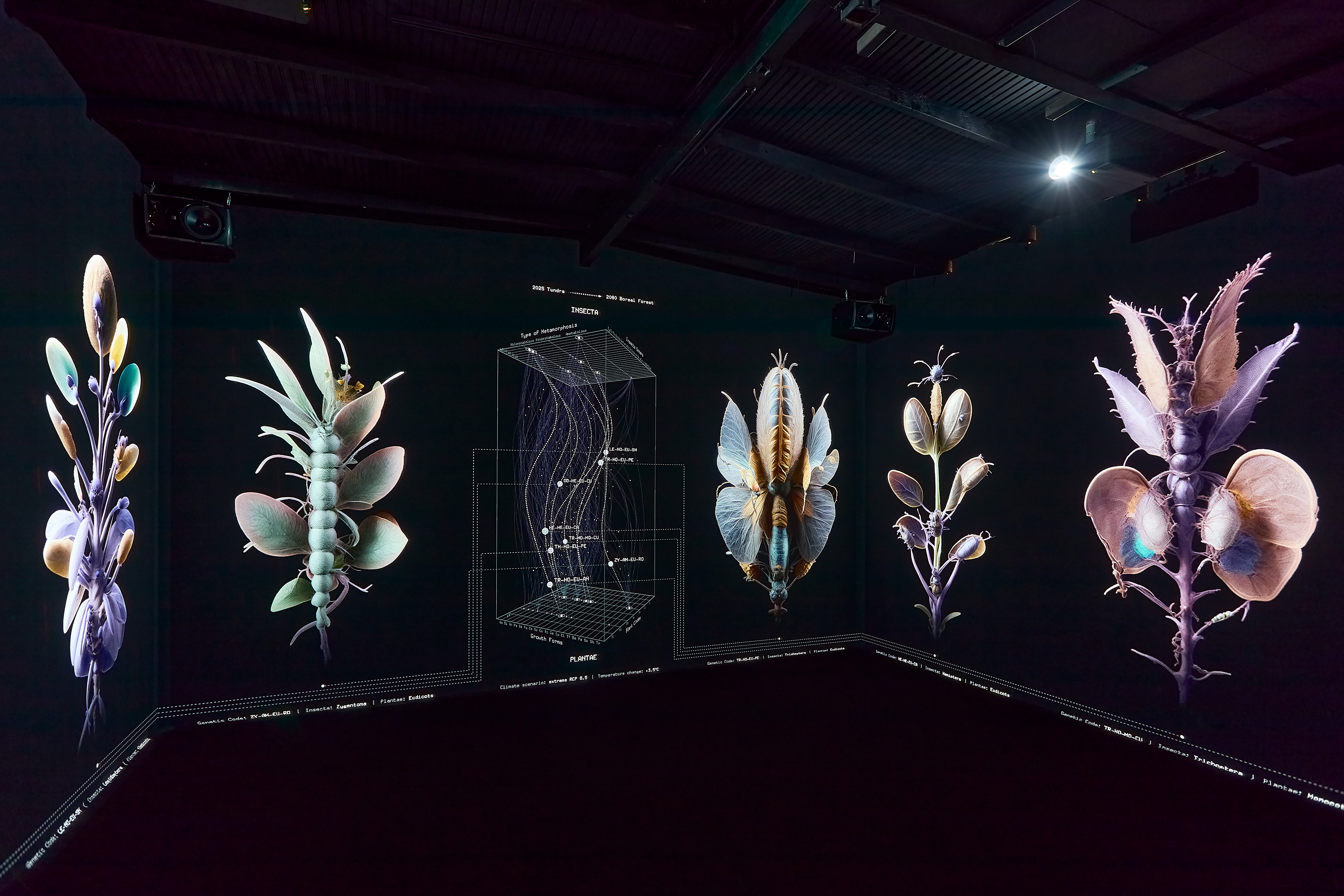
While human activities rapidly shape the planet, affect the transformation of biomes and threaten its biodiversity, evolutionary forces continue their slow processes of speciation. These forces are guided by the need to respond to new selective pressures faced by living organisms, generating adaptations and interactions between species.
The research-based artwork Mimicry explores the boundaries and thresholds of fantastical species that come into being from the hybridisation of insects and plants through a process mediated by artificial intelligence that simulates possible natural evolutionary trajectories. These beings represent nature’s search for new survival strategies, such as exaptation, where forms originally intended for one function take on new and unexpected roles, and evolutionary mimicry, in which plants and insects mutually shape their morphological and behavioural traits. Through this process, they generate a living mosaic of organisms capable of crossing and interacting with multiple biomes, facilitating genetic and morphological exchanges that mirror the mechanisms of horizontal gene transfer – a process mainly observed in microbes but also present among other organisms. Exaptation allows the acquisition of genetic traits from other species or groups of organisms, thus speeding up adaptation.
These hybrid forms are becoming living metaphors for multispecies hybridisation, anticipating the adaptive strategies of living organisms, while allowing us to speculate, to unfetter our imagination from strict notions of utility, and to fabricate monstrous forms rooted in real patterns of coexistence.
(Borbála Szalai)