Balázs Ágoston Kiss:
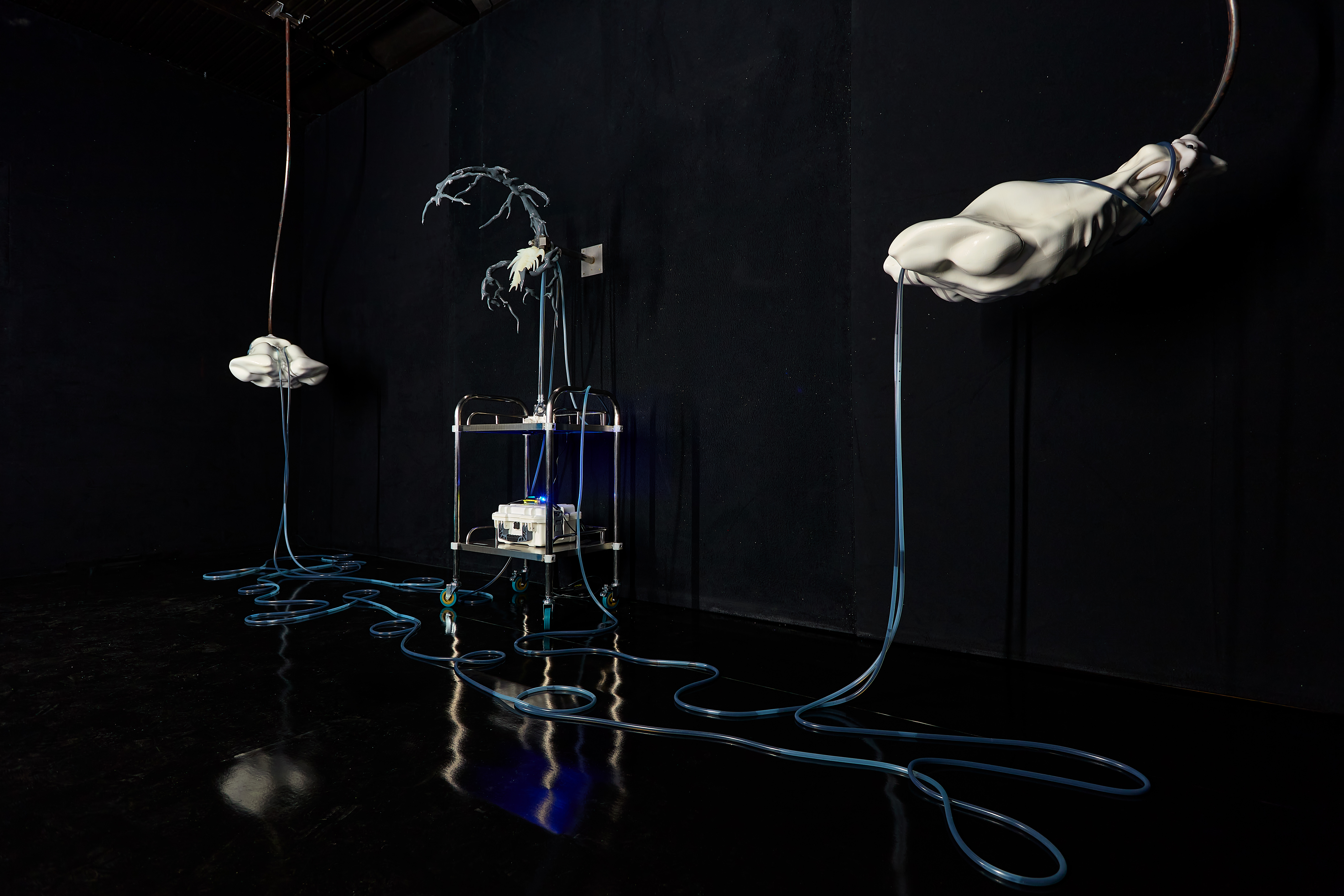
Creature no.2 – Post network –, 2025
Installation (3D-printed PLA, resins, silicone tubing, liquids, hydraulic system, microelectronics)
When entering the space with sterile, laboratory-like elements and objects of scientific and mechanical manufacturing, the visitor sees an artificial entity with a brain (computer), a spine (motor controllers/microcontrollers) and organs. Its system is inspired by the potential impact of medical advancements like bioprinting, artificial organs and soft robotics. The artwork can be seen as a speculation on a future where body modifications are fused with digital systems.
The installation includes two anthropomorphic forms on the sides (Meminor) and a sculpture inspired by Trilobites. Trilobites are extinct arthropods that lived in the seas during the Paleozoic Era and were some of the first complex animals to evolve into a hard exoskeleton, which provided protection and support. This development marked a significant step forward in the evolution of other complex, armored animals.
By incorporating elements such as the complex network of veins, which can now be accurately captured through 3D rotational angiography and CT scans, the installation presents a new way of exploring parts of the body that were previously inaccessible. The complex system of tubes both refers to a biological system and to the artificial networks (internet cables, fiber optics, oil pumps, etc.), which are indispensable components of late capitalism.
The delicate flow of fluids through tiny channels refers to microfluidics, which mirrors both neural and vascular networks, highlighting the entanglement of biological life and engineered systems. In this sense, the piece examines how medical technologies – such as precision drug delivery, organ-on-chip platforms and vascular bioprinting – reshape our understanding of the human body as a system that is simultaneously organic and machinic. The installation invites viewers to reconsider what it means to intervene, augment or simulate life at the microscale, emphasising our growing ethical responsibility as co-creators of bodily systems.
(Borbála Szalai)