Olafur Eliasson:
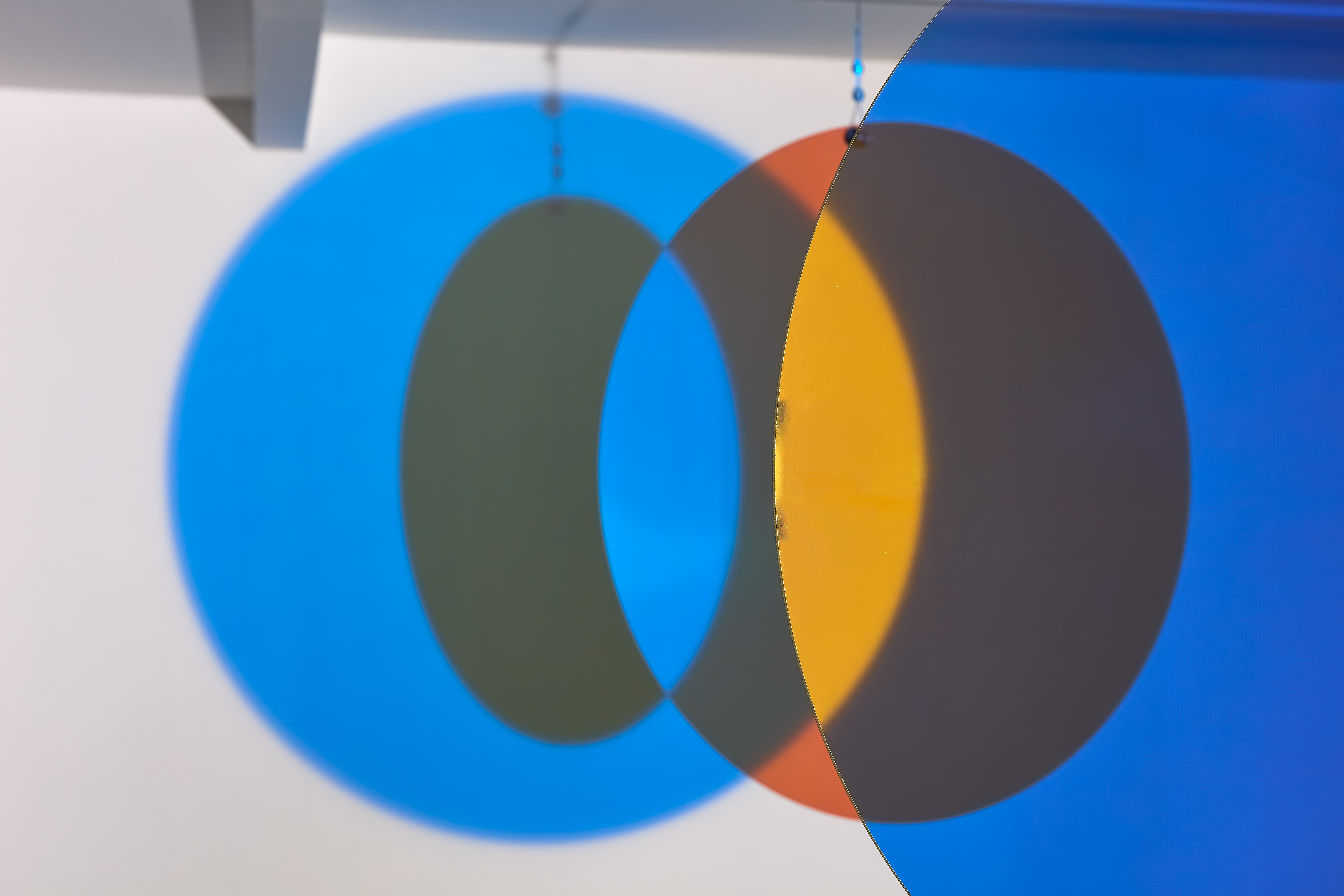
Your welcome reflected, 2003
Installation (colour-effect filter glass (blue, red), motors, HMI lamp, tripod)
Two colour-effect filter glass discs are suspended from the ceiling. Only a limited range of the spectrum of visible light can pass through each disc, while light from the remaining range is reflected. As a result, spots of complementary colours are cast on the walls. The individual perception of colours is indicated to the viewers, with their perception changing as they move around in the exhibition space.
The theory of affordances, introduced by psychologist James J. Gibson in 1977, links what objects afford to the possibilities for action available to a given organism. The theory implies that to see things is to see how to get about among them and what to do or not do with them. Gibson’s theory, which is explored in his book The Ecological Approach to Visual Perception(1), defines affordances as the “action possibilities” latent in an environment in relation to particular agents (and, therefore, dependent on their capabilities). Gibson asserted that development was driven by a complex interaction between environmental affordances and the motivated humans who perceive them, and that one is engaged in the world by creating a sense of belonging, making one’s own world by being in the world.
Olafur Eliasson has created an extensive oeuvre of optical devices dedicated to “seeing differently.” With the use of motion, projections, shadows and reflections, he renders visible the elliptical relationship between perception and knowledge, while anchoring agency in the moving body and the perceptive mind by employing what could be read as affordances. These installations complicate and recompose acts of perceiving and being in space through a visual aid: a prosthetic apparatus that allows us to become, for a while, enhanced humans.
(Borbála Szalai)
(1) James J. Gibson, The Ecological Approach to Visual Perception (Boston: Houghton Mifflin, 1979), esp. chapter 8
TBA21 Thyssen-Bornemisza Art Contemporary Collection