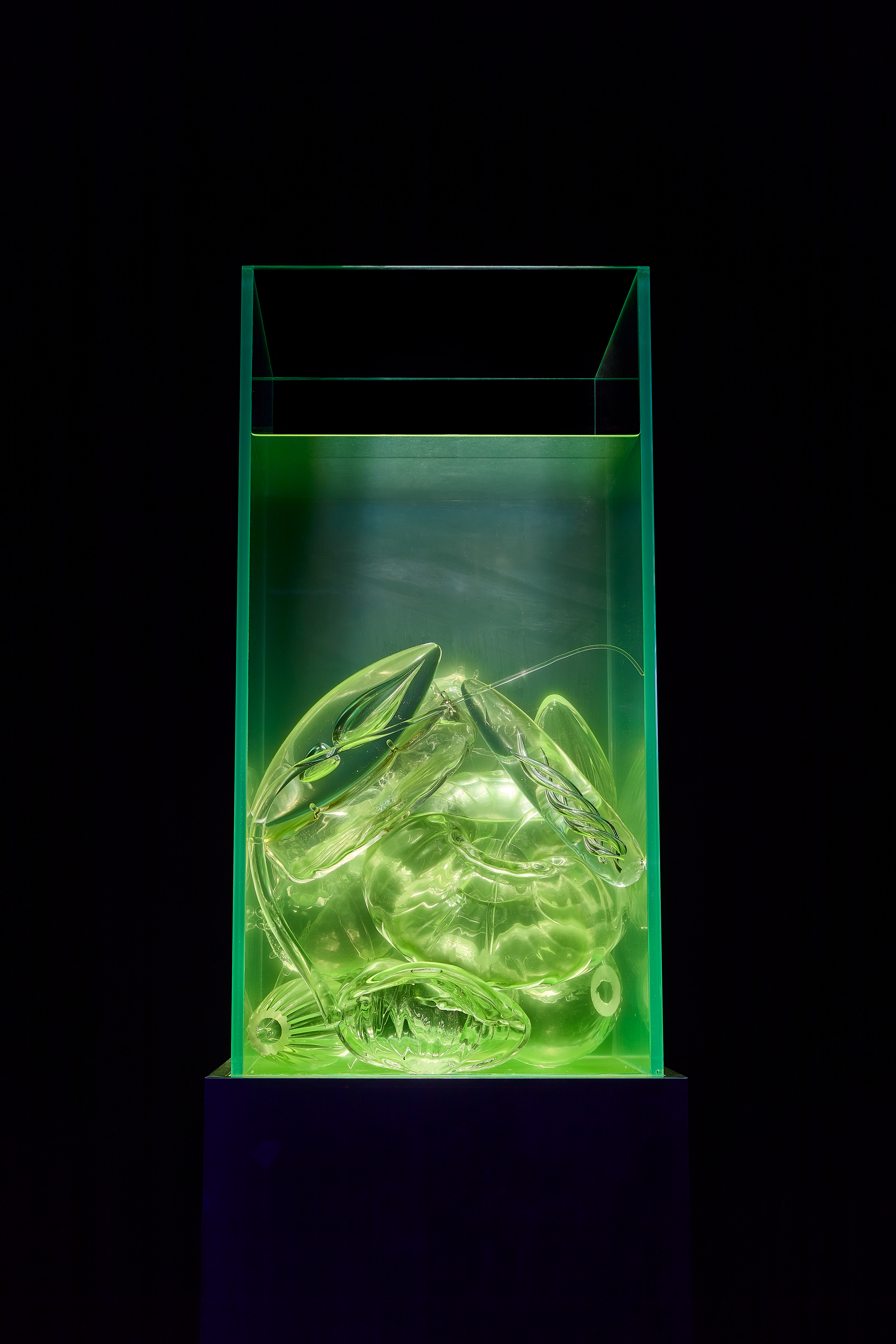
Rhoda Ting & Mikkel Bojesen:
Cyanocene, 2023
Sculptures (glass, aluminium, Chlorella algae, water)
Habitats, 2023
4K video, 16’5’’
How can we create positive living spaces for marine life in an age when the seas are polluted, temperatures are steadily rising, and the protective shells of crustaceans are thinning? The video explores relationships across species, highlighting adaptation as one of the most essential conditions for co-existence.
The video work Habitats features groups of marine creatures responding and adapting to glass sculptures. Working in collaboration with marine biologists from the Kattegat Centre in Denmark, the artists built a welcoming environment for seahorses and octopuses using glass objects in their experiment.
The visual language of Habitats draws on speculative thinking, exploring ways of creating the ethics of care. The central question of the film is what we can learn from other species and how we can create new kinds of environments at a time when changes caused by humanity have disrupted natural ecosystems. The algae on the glass sculptures are crucially important since they provide 40% of our planet’s oxygen supply through photosynthesis.
The spontaneous adaptation of seahorses and octopuses to the glass sculptures dissolves the dichotomy of the natural and the artificial, revealing that living beings relate to their environments with far greater flexibility than we might assume. The octopus’s unexpected positions and emotional responses expose a form of non-human intelligence that is capable of taking control and reshaping its surroundings on its own terms.
The video work provides a new perspective on the relationship between humans and nature, emphasising the importance of mutual adaptation.
(Kincső Ferencz)